
How Does Emsella Work?
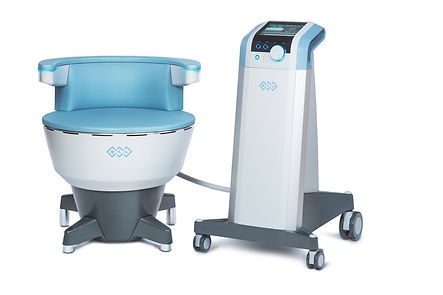
Emsella is a fully clothed, non-invasive treatment that uses High-Intensity Focused Electromagnetic technology (HIFEM®) to stimulate and strengthen the pelvic floor muscles — without surgery, probes, or downtime.
You simply sit in the Emsella chair for a 28-minute session while the device delivers electromagnetic energy through the seat, penetrating 7–10cm upward into the pelvic floor.
The technology targets the neuromuscular tissue directly via supramaximal contractions, triggering an intense pelvic floor workout that is impossible to achieve voluntarily.
Here's the 4 things you need to know to support your decision making.
1
What Are Supramaximal Contractions?
During a voluntary exercise such as a Kegel, the brain recruits approximately 30–50% of available muscle fibres at any one time — this is your Maximal Voluntary Contraction (MVC). Emsella goes significantly further.
Using HIFEM® at 2.5 Tesla, the device induces supramaximal contractions — contractions that exceed what your body can produce on its own. A single 28-minute Emsella session delivers the equivalent of 11,000 Kegel contractions.
The effect of this level of stimulation is twofold:
-
Muscle fibre hypertrophy — existing muscle fibres grow stronger through the creation of new protein strands
-
Muscle fibre hyperplasia — entirely new muscle fibres are created
The result is a meaningfully stronger, better-functioning pelvic floor.
2
The Evidence
Emsella is not a wellness trend — it is an FDA-cleared and CE-marked medical device with a growing body of clinical evidence.
Regulatory clearance:
-
FDA Cleared for non-invasive electromagnetic stimulation of pelvic floor musculature for the rehabilitation of weak pelvic muscles and restoration of neuromuscular control in male and female urinary incontinence
-
Medical CE Marked for pelvic floor muscle strengthening in the treatment of urinary incontinence in male and female patients
3
Clinical Outcomes
Clinical outcomes:
-
85–95% patient satisfaction rate at six-month follow-up
-
Female patients with sexual dysfunction symptoms improved on average by 51% (measured by FSFI score)
-
Male patients with erectile dysfunction saw a 37% improvement in maintaining erection during intercourse, with penile tissue density increasing by 69%
-
Patients typically observe improvement after a single session, with results continuing to develop over the following weeks
4
Scale
Scale of need:
-
Pelvic floor muscle disorders are projected to increase by 35% over the next two decades, reaching approximately 1.6 million clinical visits per year by 2030 (Bordoni et al., StatPearls, July 2023)
-
Urinary incontinence is so prevalent that if it were a country, it would be the third largest in the world (GFI Forum, 2018)